Higher Education Accreditation Changes 2026: What to Know

Understanding the upcoming higher education accreditation changes for 2026 is critical for students and institutions alike, as these updates will redefine quality standards and federal funding eligibility across the United States.
The landscape of higher education is continuously evolving, and 2026 is poised to bring significant shifts in how institutions are evaluated and recognized. For both current and prospective students, and for the universities and colleges themselves, keeping abreast of these higher education accreditation changes for 2026 is not merely advisable, it’s absolutely essential for navigating the future of learning and professional development.
Understanding the Foundation of Accreditation in US Higher Education
Accreditation serves as the bedrock of quality assurance in US higher education. It’s a voluntary, peer-review process that evaluates institutions and programs to ensure they meet established standards of excellence. This process is crucial not only for maintaining academic integrity but also for enabling students to access federal financial aid, transfer credits, and gain credible qualifications for their careers.
Historically, accreditation has been a decentralized system, overseen by various regional and national accrediting agencies recognized by the Council for Higher Education Accreditation (CHEA) and the U.S. Department of Education (USDE). These bodies are responsible for setting and enforcing standards related to curriculum, faculty qualifications, student support services, financial stability, and institutional effectiveness. The upcoming changes aim to refine and strengthen this framework, addressing contemporary challenges and opportunities in education.
The Role of Accrediting Agencies
Accrediting agencies are the gatekeepers of quality. They operate independently, conducting rigorous reviews of institutions to ensure they provide a valuable educational experience. Their decisions impact everything from an institution’s public perception to its ability to receive federal funding. The 2026 changes are expected to put a greater emphasis on:
- Student outcomes and success metrics.
- Institutional adaptability to evolving educational needs.
- Transparency in reporting and accountability.
Understanding the fundamental purpose of accreditation provides context for why these impending changes are so significant. They aren’t just bureaucratic adjustments; they are designed to ensure that higher education continues to serve students and society effectively in a rapidly changing world.
Key Drivers Behind the 2026 Accreditation Reforms
The forthcoming higher education accreditation changes for 2026 are not arbitrary; they are a direct response to several critical pressures and evolving needs within the educational sector. These drivers reflect a collective desire to enhance accountability, promote innovation, and ensure that higher education remains relevant and valuable for all stakeholders. Understanding these underlying motivations is key to grasping the intent and potential impact of the reforms.
One primary driver is the increasing scrutiny on student debt and graduate employability. Policymakers and the public are demanding greater evidence that higher education provides a tangible return on investment. This has led to a push for accreditation standards that more explicitly link institutional quality to measurable student success outcomes, such as graduation rates, post-graduation employment, and earning potential.
Technological Advancements and Online Learning
The rapid expansion of online learning, accelerated by recent global events, has highlighted the need for accreditation standards that can effectively evaluate digital educational offerings. Traditional accreditation models were often designed with brick-and-mortar institutions in mind, and adapting them to the nuances of virtual classrooms, hybrid models, and competency-based education is a significant challenge. The 2026 reforms aim to:
- Develop more robust criteria for assessing the quality of online programs.
- Ensure equitable access and support for distance learners.
- Promote innovation in instructional design and technology integration.
Another significant factor is the call for greater equity and access in higher education. There’s a growing recognition that accreditation standards must do more to address disparities in educational outcomes and ensure that institutions are serving diverse student populations effectively. This includes focusing on support services for underrepresented groups and ensuring that educational pathways are accessible to all.
Finally, the reforms are also driven by a desire to streamline the accreditation process itself, making it more efficient, less burdensome for institutions, and more transparent for the public. This involves a re-evaluation of reporting requirements, site visit protocols, and the overall review cycle to ensure that the process adds genuine value without creating unnecessary administrative overhead. These multifaceted drivers underscore the comprehensive nature of the upcoming accreditation changes.
Impact on Students: What the Changes Mean for You
For students, the higher education accreditation changes for 2026 carry profound implications, directly affecting everything from financial aid eligibility to the recognition of their degrees. It’s crucial for prospective and current students to be aware of these shifts to make informed decisions about their educational journeys and future career paths.
Perhaps the most immediate impact relates to federal financial aid. The U.S. Department of Education relies on accreditation as a primary indicator of institutional quality when determining eligibility for federal student loans, grants, and other aid programs. If an institution fails to meet the updated accreditation standards, or if its accreditation status changes significantly, students attending that institution could face disruptions in their financial aid packages.
Transferability of Credits and Degree Recognition
The ability to transfer credits seamlessly between institutions is a common concern for many students. The 2026 changes aim to standardize certain aspects of credit transfer, potentially making it easier for students to move between accredited programs without losing valuable academic progress. However, it also means that institutions that do not align with the new standards might find their credits less readily accepted elsewhere.
- Increased emphasis on competency-based learning may alter how credits are awarded.
- Greater transparency in course equivalencies could simplify transfer decisions.
- Students should verify their program’s accreditation status regularly.
Ultimately, the goal of these reforms is to enhance the value and credibility of higher education degrees. For students, this means that a degree from an institution that successfully navigates the new accreditation landscape will likely hold even greater weight in the job market. Conversely, degrees from institutions struggling with accreditation could face skepticism from employers or other educational bodies. Staying informed and choosing institutions with strong accreditation standing will be more important than ever.
Challenges and Opportunities for Higher Education Institutions
The impending higher education accreditation changes for 2026 present a dual landscape of significant challenges and transformative opportunities for colleges and universities across the United States. Navigating these reforms will require strategic planning, resource allocation, and a proactive approach to institutional self-assessment and improvement.
One of the primary challenges institutions will face is adapting their existing programs and administrative structures to meet the heightened and potentially revised accreditation standards. This may involve comprehensive curriculum reviews, investment in new technologies for online learning, professional development for faculty, and an overhaul of data collection and reporting systems to demonstrate compliance with new outcome-based metrics. The financial and human resource implications of these adjustments can be substantial.
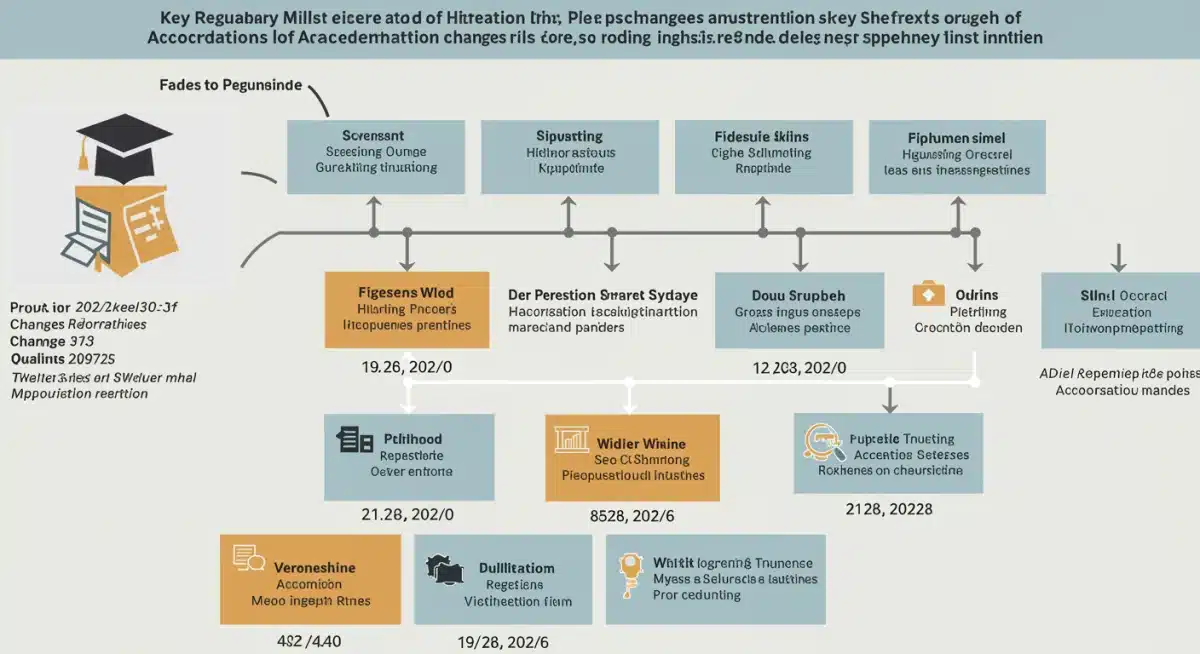

Embracing Innovation Through Compliance
While compliance might seem daunting, the changes also offer a unique opportunity for institutions to innovate and differentiate themselves. By proactively addressing the new standards, universities can:
- Strengthen their commitment to student success and career readiness.
- Enhance the quality and flexibility of their educational offerings.
- Improve operational efficiency and transparency.
Institutions that embrace these changes as an impetus for genuine improvement, rather than merely a regulatory hurdle, stand to gain a competitive advantage. This includes a chance to re-evaluate their mission, refine their pedagogical approaches, and better align their offerings with the evolving demands of the workforce and society. The reforms could catalyze a period of significant growth and redefinition for institutions willing to adapt and evolve.
The Role of Data and Technology in Future Accreditation
As we approach the higher education accreditation changes for 2026, the role of data and technology is becoming increasingly central to how institutions demonstrate quality and meet evolving standards. The shift towards outcome-based accreditation necessitates robust data collection, analysis, and reporting capabilities, making technological infrastructure a critical component of institutional compliance and success.
Accrediting agencies are placing a greater emphasis on empirical evidence of student learning, success rates, and post-graduation outcomes. This means institutions must be able to track and analyze a wide range of data points, from student retention and graduation rates to alumni employment and salary data. Learning management systems (LMS), student information systems (SIS), and enterprise resource planning (ERP) systems will need to be integrated and optimized to provide comprehensive and accurate data for accreditation reviews.
Leveraging Analytics for Continuous Improvement
Beyond mere reporting, institutions have an opportunity to leverage advanced analytics to drive continuous improvement. By analyzing data on student performance, engagement, and progression, colleges and universities can identify areas for intervention, refine pedagogical strategies, and tailor support services to meet diverse student needs more effectively. This proactive use of data can transform the accreditation process from a periodic compliance exercise into an ongoing cycle of self-assessment and enhancement.
- Predictive analytics can identify at-risk students, enabling timely support.
- Data visualization tools can make complex outcomes understandable for stakeholders.
- Secure data infrastructure is essential for protecting student privacy and integrity.
Furthermore, technology will play a vital role in facilitating the accreditation review process itself. Online portals for document submission, virtual site visits, and digital communication platforms can streamline interactions between institutions and accrediting bodies, making the process more efficient and less resource-intensive. Embracing these technological advancements will be crucial for institutions to not only meet the 2026 accreditation requirements but also to thrive in the digital age of higher education.
Preparing for the 2026 Accreditation Landscape: A Strategic Guide
As the higher education accreditation changes for 2026 draw nearer, proactive preparation is paramount for both institutions and students. A strategic approach will ensure compliance, mitigate risks, and position stakeholders for success within the evolving educational ecosystem. This involves a multi-faceted plan that addresses regulatory requirements, technological integration, and a culture of continuous improvement.
For institutions, the first step is to conduct a thorough internal audit of current programs, policies, and data collection practices against anticipated new accreditation standards. This self-assessment should identify gaps and areas requiring attention, allowing for the development of a detailed action plan. Engaging faculty, staff, and leadership in this process is crucial to foster a shared understanding and commitment to the necessary changes.
Key Preparatory Steps for Institutions
- Review current accreditation handbooks: Understand existing requirements and anticipate likely modifications.
- Invest in data infrastructure: Ensure systems can effectively track and report student outcomes.
- Professional development: Train faculty and staff on new pedagogical approaches and assessment methods.
- Stakeholder engagement: Communicate anticipated changes to students, alumni, and the community.
For students, preparation involves staying informed about their chosen institution’s accreditation status and understanding how these changes might impact their academic and financial standing. Regularly checking official communications from their college or university, as well as resources from the U.S. Department of Education and CHEA, will be vital. Prospective students should prioritize institutions with a strong track record of accreditation compliance and transparent reporting.
Ultimately, successful navigation of the 2026 accreditation landscape will depend on foresight, adaptability, and a commitment to upholding the highest standards of educational quality. By strategically preparing now, institutions can transform potential challenges into opportunities for growth and innovation, while students can confidently pursue their educational goals.
| Key Aspect | Brief Description |
|---|---|
| Student Outcomes Focus | Increased emphasis on measurable student success, including graduation rates and employment. |
| Online Learning Standards | New or refined criteria for evaluating the quality and effectiveness of online and hybrid programs. |
| Financial Aid Eligibility | Accreditation status directly impacts student access to federal financial aid programs. |
| Data & Technology Role | Greater reliance on data analytics and technology for reporting and demonstrating compliance. |
Frequently Asked Questions About 2026 Accreditation Changes
The changes are driven by demands for greater accountability, improved student outcomes, adaptation to online learning advancements, and enhanced equity in higher education. They aim to ensure degrees remain relevant and valuable in a changing world.
Federal financial aid eligibility is tied to an institution’s accreditation status. If an institution fails to meet new standards, students could experience disruptions in federal grants or loans. Always verify your school’s standing.
The reforms aim for greater standardization, potentially easing credit transfers. However, institutions not fully compliant with new standards might have their credits less readily accepted. It’s crucial to check with both sending and receiving institutions.
Institutions should conduct internal audits, invest in data infrastructure, provide professional development for staff, and communicate proactively with stakeholders. Strategic planning is key to adapting to the new regulatory environment effectively.
Official information can be found on the websites of the U.S. Department of Education (USDE) and the Council for Higher Education Accreditation (CHEA). These are the primary sources for detailed guidance and updates on accreditation reforms.
Conclusion
The higher education accreditation changes for 2026 represent a pivotal moment for the future of learning in the United States. These comprehensive reforms are designed to elevate academic quality, ensure institutional accountability, and better prepare students for the demands of a dynamic global landscape. Both students and institutions must remain vigilant, proactive, and informed to navigate this evolving environment successfully. By embracing these changes, higher education can continue to serve as a beacon of opportunity and a catalyst for societal progress, ensuring that degrees remain valuable and education remains accessible to all.