2026 Social Security Tax Cap: What You Need to Know for Payroll Deductions

Understanding the intricacies of payroll deductions can often feel like navigating a complex maze. Among the many components that make up our paychecks, Social Security taxes stand out as a fundamental contribution to a vital social safety net. However, these contributions aren’t limitless; they are subject to an annual cap, which changes periodically. As we look ahead, the 2026 Social Security Tax Cap is a critical figure that employees, employers, and financial planners need to comprehend thoroughly.
The Social Security Administration (SSA) annually adjusts the maximum amount of earnings subject to Social Security tax, known as the wage base limit. This adjustment is based on changes in the national average wage index. For those earning above this limit, their Social Security tax contributions cease once their cumulative earnings reach the cap. This article will delve deep into what the 2026 Social Security Tax Cap entails, its implications for both employees and employers, how it’s calculated, and strategies for navigating its financial impact.
What is the Social Security Tax Cap?
Before we project into 2026, it’s essential to grasp the fundamental concept of the Social Security tax cap. Social Security is funded through dedicated payroll taxes, often referred to as FICA (Federal Insurance Contributions Act) taxes. This tax is levied on both employees and employers. For employees, the current Social Security tax rate is 6.2% of their earnings, and employers pay an additional 6.2%, making a total of 12.4% on an employee’s wages.
However, this 6.2% (or 12.4% combined) is not applied to all earnings indefinitely. There’s a maximum amount of earnings that is subject to Social Security tax in any given year. This is the wage base limit, or the Social Security tax cap. Once an individual’s earnings for the year exceed this cap, no further Social Security taxes are withheld from their pay, nor are employers required to contribute on earnings above this threshold. This cap applies solely to the Social Security portion of FICA taxes; the Medicare tax (1.45% for employees and 1.45% for employers, with an additional 0.9% for high earners) does not have an earnings cap.
The primary reason for this cap is to ensure the long-term solvency and fairness of the Social Security system. It limits the amount of benefits an individual can receive in retirement, as benefits are tied to lifetime earnings. By capping contributions, the system also caps potential payouts, creating a more predictable financial model.
How the Social Security Tax Cap is Determined
The Social Security Administration (SSA) is responsible for determining the annual wage base limit. This determination is not arbitrary; it follows a specific formula mandated by law. The cap is adjusted annually based on the national average wage index (AWI). The AWI reflects changes in average wages and salaries paid to U.S. workers. The SSA compares the AWI from the previous year to the AWI from the year before that and applies the percentage increase to the current wage base limit.
For example, to determine the 2025 wage base limit, the SSA would compare the AWI from 2023 to 2022. The exact methodology involves complex calculations, but the core principle is that as average wages rise, so too does the Social Security tax cap. This ensures that the system remains relevant and adequately funded in an evolving economic landscape.
While the exact 2026 Social Security Tax Cap won’t be officially announced until late 2025, we can make informed projections based on historical trends and economic forecasts. Factors such as inflation, economic growth, and labor market conditions all play a role in influencing the national average wage index and, consequently, the cap.
Projecting the 2026 Social Security Tax Cap
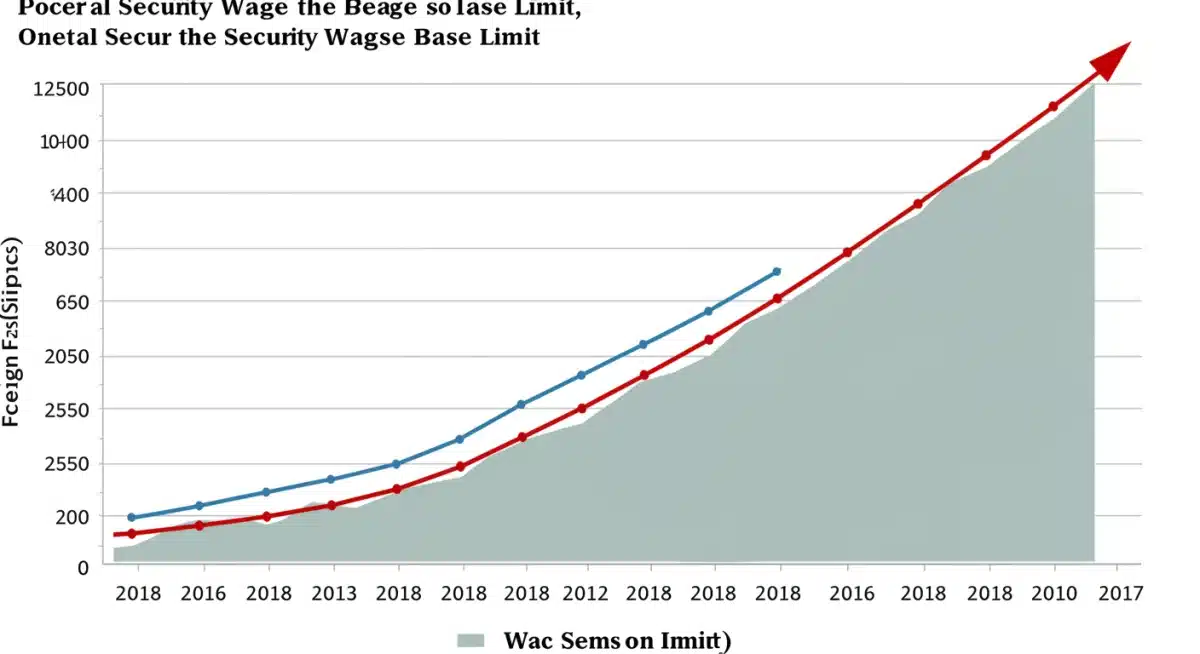
Estimating the 2026 Social Security Tax Cap requires analyzing historical data and current economic projections. In recent years, the cap has seen consistent increases, reflecting a growing wage index. For instance, the wage base limit increased from $147,000 in 2022 to $160,200 in 2023, and then to $168,600 in 2024. These increments typically hover around 3% to 9% annually, depending on economic performance.
Given sustained wage growth and ongoing inflation, it is reasonable to anticipate another increase for 2026. While specific numbers are speculative until the SSA’s official announcement, a conservative estimate might place the 2026 Social Security Tax Cap in the range of $175,000 to $185,000. This projection assumes a continued, albeit potentially moderating, increase in the national average wage index. Businesses and individuals should factor in the possibility of an increase when planning their payroll and personal finances for 2026.
It’s crucial for employers, especially those with highly compensated employees, to monitor these projections closely. Early awareness allows for better budgeting and ensures compliance with payroll tax obligations. Similarly, high-earning individuals can use these estimates to refine their personal tax planning and understand their take-home pay more accurately.
Impact on Employees: What the 2026 Social Security Tax Cap Means for Your Paycheck
For employees, the 2026 Social Security Tax Cap directly impacts how much Social Security tax is withheld from their paychecks. If your annual earnings are below the cap, you will pay Social Security tax on all your earnings. However, if your earnings exceed the cap, your Social Security tax contributions will cease once your year-to-date earnings reach that limit. This means that for a portion of the year, usually later in the year for high-income earners, you will see a slight increase in your net pay because the 6.2% Social Security tax will no longer be deducted.
Let’s consider an example: If the 2026 Social Security Tax Cap is set at $180,000, and you earn $200,000 annually, you will pay Social Security tax on the first $180,000 of your income. The remaining $20,000 will not be subject to Social Security tax. This results in a tax saving of $1,240 (6.2% of $20,000) for the year. While this might seem like a bonus, it’s essential to remember that this also means your future Social Security benefits will be based on a maximum of $180,000 of covered earnings for that year, not your full $200,000.
This dynamic is particularly relevant for individuals who switch jobs mid-year, especially if their combined earnings from multiple employers exceed the cap. In such cases, it’s possible to overpay Social Security taxes. If each employer withholds Social Security tax up to the cap independently, an employee might have paid more than the maximum required. Any overpayment can be recovered when filing your annual income tax return using Form 1040. Understanding this mechanism is vital for accurate tax planning and ensuring you don’t leave money on the table.
Impact on Employers: Navigating the 2026 Social Security Tax Cap
For employers, the 2026 Social Security Tax Cap has significant implications for payroll processing, budgeting, and compliance. Employers are responsible for withholding the employee’s share of Social Security tax and remitting it, along with their own matching contribution, to the IRS. This means that for each employee, the employer also pays 6.2% of their wages up to the annual wage base limit.
When an employee’s earnings reach the 2026 Social Security Tax Cap, the employer’s obligation to contribute their matching 6.2% also ceases. This can lead to a slight reduction in payroll expenses for highly compensated employees later in the year. However, it also requires meticulous tracking of each employee’s year-to-date earnings to ensure accurate withholding and contributions.
Failure to correctly apply the Social Security tax cap can lead to penalties from the IRS. Over-withholding can result in employee dissatisfaction and the need for complex adjustments, while under-withholding can lead to fines and interest charges. Therefore, robust payroll systems and vigilant monitoring are paramount for employers. Payroll software solutions are typically designed to automatically track these limits, but it’s always wise for businesses to conduct periodic audits to ensure accuracy.
For businesses with a large number of high-earning employees, the cumulative effect of the Social Security tax cap can be substantial. Budgeting for payroll taxes must account for this limit, especially when forecasting expenses for the upcoming year. It’s also a factor in compensation planning, as the total cost of an employee includes these payroll taxes.
Comparing Social Security and Medicare Taxes
While often grouped under FICA, it’s important to distinguish between Social Security and Medicare taxes, especially concerning the cap. As discussed, the 2026 Social Security Tax Cap will limit the earnings subject to Social Security contributions. However, Medicare taxes operate differently.
The Medicare tax rate is 1.45% for employees and 1.45% for employers, for a total of 2.9%. Crucially, there is no wage base limit for Medicare taxes. This means that all earned income, regardless of how high, is subject to Medicare tax. Furthermore, high-income earners are subject to an Additional Medicare Tax of 0.9% on earnings above certain thresholds ($200,000 for single filers, $250,000 for married filing jointly, and $125,000 for married filing separately). This additional tax is only paid by the employee, not matched by the employer.
This distinction is vital for both employees and employers when calculating total payroll tax liabilities. An employee earning well above the 2026 Social Security Tax Cap will still see Medicare taxes deducted from every dollar earned, along with the potential Additional Medicare Tax. Employers must continue to pay their 1.45% share of Medicare tax on all employee wages, without any cap.
Self-Employed Individuals and the Social Security Tax Cap
Self-employed individuals face a slightly different scenario regarding Social Security and Medicare taxes, often referred to as Self-Employment Contributions Act (SECA) tax. For self-employed individuals, they are responsible for both the employee and employer portions of FICA taxes. This means they pay a total of 12.4% for Social Security (up to the 2026 Social Security Tax Cap) and 2.9% for Medicare on their net earnings from self-employment.
When calculating their SECA tax, self-employed individuals first determine their net earnings from self-employment. They can then deduct one-half of their self-employment tax when calculating their adjusted gross income (AGI) for income tax purposes. The 2026 Social Security Tax Cap will apply to the Social Security portion of their SECA tax, meaning once their net earnings reach the cap, they will no longer pay the 12.4% Social Security tax but will continue to pay the 2.9% Medicare tax on all earnings.
For self-employed individuals, accurately tracking income and expenses throughout the year is crucial for estimating their SECA tax liability and making quarterly estimated tax payments. Understanding the projected 2026 Social Security Tax Cap will help them refine these estimates and avoid underpayment penalties.
Strategies for Financial Planning with the 2026 Social Security Tax Cap
Navigating the 2026 Social Security Tax Cap effectively requires proactive financial planning for both individuals and businesses.
For Employees:
- Budgeting for Increased Take-Home Pay: If you are a high-income earner, anticipate a slight increase in your net pay once your earnings surpass the cap. You can choose to save this extra income, invest it, or use it to pay down debt.
- Reviewing Withholding: If you anticipate exceeding the cap, especially if you change jobs, review your W-4 form to ensure your federal income tax withholding is accurate. Overpaying Social Security tax through multiple employers can be recovered, but it’s better to avoid the overpayment if possible.
- Understanding Future Benefits: Remember that the cap limits the earnings considered for your Social Security benefit calculation. While you might save on taxes in the short term, this also sets a ceiling on your future benefits.
- Consulting a Financial Advisor: A financial advisor can help you integrate the Social Security tax cap into your broader financial and retirement planning.
For Employers:
- Accurate Payroll Processing: Ensure your payroll software is up-to-date and correctly applies the 2026 Social Security Tax Cap for each employee. Regular audits can prevent errors.
- Budgeting and Forecasting: Incorporate the projected cap into your annual payroll tax budgeting. This is particularly important for businesses with a significant number of high-earning employees.
- Employee Communication: Educate your high-earning employees about how the cap affects their paychecks. Transparency can help manage expectations and answer common questions.
- Compliance Checks: Stay informed about any changes or updates from the SSA or IRS regarding payroll tax regulations to ensure continuous compliance.
Potential Future Changes to the Social Security Tax Cap
While the annual adjustment of the Social Security tax cap is a standard procedure, there are ongoing discussions and proposals regarding the Social Security system’s long-term solvency. Some proposals suggest removing the cap entirely, meaning all earnings would be subject to Social Security tax. Other proposals involve increasing the tax rate or adjusting the benefit calculation formula.
Any significant changes to the Social Security system, particularly those affecting the wage base limit, would have profound implications for individuals and businesses. Removing the cap, for instance, would dramatically increase payroll tax burdens for high-income earners and their employers. This would generate more revenue for Social Security but could also be seen as a disincentive for higher earnings and a significant increase in business costs.
As of now, for 2026, we anticipate the cap to be adjusted based on the national average wage index as per current law. However, it’s prudent for all stakeholders to stay informed about legislative discussions concerning Social Security reform, as these could introduce more fundamental changes in the future. The political landscape and economic conditions can influence the urgency and direction of such reforms.

The Role of the Social Security Trust Funds
The Social Security tax cap plays a crucial role in the financial health of the Social Security Trust Funds (Old-Age and Survivors Insurance, and Disability Insurance). These trust funds pay benefits to retirees, survivors, and disabled workers. The revenue generated from Social Security taxes, up to the annual cap, directly feeds into these funds.
The annual reports from the Social Security Board of Trustees provide projections on the solvency of these funds. While the system faces long-term financial challenges, the adjustments to the Social Security tax cap, along with other parameters, are mechanisms designed to help maintain its stability. An increasing cap means more revenue for the trust funds, which helps to cover projected benefit payments.
Understanding the connection between the 2026 Social Security Tax Cap and the broader financial health of Social Security can provide context for why these adjustments are made and their importance to millions of Americans who rely on these benefits.
Practical Steps for Payroll Professionals
For payroll professionals, the upcoming 2026 Social Security Tax Cap requires several practical steps to ensure a smooth transition and compliance:
- Monitor Official Announcements: Stay vigilant for the official announcement of the 2026 wage base limit from the Social Security Administration, typically released in October or November of the preceding year.
- Update Payroll Systems: Ensure your payroll software is updated promptly with the new cap. Most reputable payroll providers will implement these changes automatically, but verification is key.
- Communicate Changes: Inform relevant employees and management about the new cap and its potential impact on paychecks and employer contributions.
- Review Employee Earnings: Conduct a review of employee earnings, especially those near or above the current cap, to anticipate when the new cap will be reached for individual employees.
- Train Payroll Staff: Ensure all payroll staff are aware of the new cap and any associated procedural changes or considerations.
These proactive measures will help minimize errors, ensure compliance, and maintain employee satisfaction regarding payroll accuracy.
Conclusion
The 2026 Social Security Tax Cap is more than just a number; it’s a critical component of payroll deductions, financial planning, and the broader Social Security system. For employees, it dictates when their Social Security tax contributions will cease, potentially leading to a higher take-home pay later in the year. For employers, it influences payroll costs and demands meticulous record-keeping and compliance.
While the exact figure for 2026 is yet to be officially announced, historical trends suggest another increase is likely. By staying informed, understanding the mechanics of the cap, and implementing proactive financial and payroll strategies, both individuals and businesses can effectively navigate its implications. As discussions around Social Security’s future continue, remaining aware of potential legislative changes will also be crucial. The Social Security tax cap, in its annual adjustment, serves as a reminder of the dynamic nature of our tax system and the importance of continuous vigilance in financial matters.