2026 Social Security Break-Even: Claim Early or Delay?
Understanding the optimal time to claim Social Security benefits in 2026 involves analyzing Social Security break-even 2026 points, which compare the total lifetime benefits received from early versus delayed filing strategies.
For many Americans approaching retirement, the decision of when to start collecting Social Security benefits is one of the most significant financial choices they will make. This choice, often framed as early claiming vs. delayed filing: analyzing 2026 Social Security break-even points, can have profound implications for your financial security throughout the golden years. It’s not just about when you start receiving money; it’s about maximizing your total lifetime benefits and ensuring your retirement aligns with your lifestyle and financial needs.
Understanding Social Security Benefits in 2026
Social Security remains a cornerstone of retirement planning for millions, providing a vital income stream. As we look towards 2026, the fundamental rules guiding these benefits continue to evolve, making it essential to understand how your claiming decision impacts your financial future. Your Full Retirement Age (FRA) is a critical factor, determining the age at which you are entitled to 100% of your primary insurance amount (PIA).
Claiming benefits before your FRA leads to a permanent reduction in monthly payments, while delaying beyond your FRA, up to age 70, results in delayed retirement credits that permanently increase your monthly benefit. These adjustments are central to calculating any potential break-even points. The calculation for 2026 will account for cost-of-living adjustments (COLAs) and other minor legislative tweaks that might influence the overall benefit landscape.
The Full Retirement Age (FRA)
For individuals born in 1960 or later, the Full Retirement Age is 67. This age is crucial because it marks the point where you qualify for your full, unreduced Social Security benefit. Claiming before 67 means accepting a reduced monthly payment, while delaying past 67 increases your monthly checks.
- Born before 1954: FRA is 66.
- Born between 1955 and 1959: FRA gradually increases from 66 and 2 months to 66 and 10 months.
- Born 1960 or later: FRA is 67.
Understanding your specific FRA is the first step in evaluating your claiming options. It forms the baseline against which all early or delayed claiming scenarios are measured, directly influencing the monthly benefit amount you can expect to receive.
In essence, the 2026 Social Security landscape will largely mirror previous years in terms of claiming strategies, but with updated COLA figures and a consistent emphasis on the FRA. Future retirees must grasp these basics to make informed decisions about when to initiate their benefits, setting the stage for a secure financial retirement.
The Lure of Early Claiming: Pros and Cons for 2026
Many individuals find the prospect of receiving Social Security benefits as early as age 62 incredibly appealing. This immediate access to funds can offer a sense of financial relief and the ability to retire sooner than anticipated. However, early claiming comes with a significant trade-off: a permanent reduction in your monthly benefit amount. For those reaching age 62 in 2026, this reduction can be as much as 30% compared to claiming at their Full Retirement Age of 67.
The decision to claim early is often driven by various factors, including health concerns, job loss, or the desire to enjoy retirement while still relatively young and active. While the immediate cash flow can be beneficial, it’s crucial to weigh this against the long-term impact on your total lifetime income. This is where the concept of a break-even point becomes particularly relevant.
Immediate Financial Relief vs. Reduced Lifetime Benefits
Opting for early claiming provides immediate financial liquidity, which can be advantageous for those facing unexpected expenses, seeking to pay off debts, or simply wanting to begin their retirement journey without delay. This initial boost can improve quality of life in the short term.
- Pros: Immediate income, potential to invest early benefits (though risky), earlier retirement.
- Cons: Permanently reduced monthly payments, potentially lower total lifetime benefits, reduced survivor benefits for spouses.
The reduction percentage is fixed once you start claiming, meaning you’ll receive a smaller check every month for the rest of your life. This reduction also affects survivor benefits for your spouse, making it a joint decision for many couples. Understanding this permanent impact is key to evaluating if early claiming aligns with your overall financial strategy for 2026 and beyond.
Ultimately, the decision to claim early should be a carefully considered one, taking into account not only immediate needs but also long-term financial projections and potential life expectancy. It’s a balance between present desires and future financial security, with the break-even point serving as a critical analytical tool.
The Power of Delayed Filing: Boosting Your 2026 Benefits
On the other end of the spectrum is delayed filing, a strategy that many financial advisors advocate for those who can afford to wait. By delaying the start of your Social Security benefits past your Full Retirement Age (FRA) up to age 70, you earn delayed retirement credits. These credits result in a significant and permanent increase in your monthly benefit amount, potentially leading to substantially higher lifetime income, especially if you live a long life.
For those reaching their FRA in 2026, delaying benefits can mean an 8% annual increase in their benefit amount for every year they wait past FRA, up to age 70. This compounding effect can translate into a much more robust monthly income in retirement, offering greater financial stability and peace of mind. The decision to delay often stems from good health, continued employment, or a desire to maximize guaranteed income later in life.
Maximizing Monthly Payouts Through Delayed Retirement Credits
The primary advantage of delayed filing is the permanent boost to your monthly Social Security check. This increase can significantly enhance your purchasing power throughout retirement, helping to cover rising living costs and unexpected expenses.
- Benefits of delaying: Higher monthly payments, increased total lifetime benefits (for longer lifespans), enhanced survivor benefits for spouses, potential for greater financial security.
- Considerations: Need for alternative income during the delay period, health status (e.g., if life expectancy is shorter, early claiming might be better).
The 8% annual increase is a powerful incentive, effectively guaranteeing a return on your decision to wait. This strategy is particularly appealing to those who expect to live into their 80s or beyond, as the cumulative effect of higher monthly payments can far outweigh the benefits of claiming earlier. It’s a strategic move to leverage the system for maximum personal gain over the long haul.
Delaying your Social Security claim requires careful planning to ensure you have adequate income to cover expenses until benefits begin. However, for those who can bridge this gap, the long-term financial rewards can be substantial, making it a compelling option for maximizing retirement income in 2026.
Calculating Your 2026 Social Security Break-Even Point
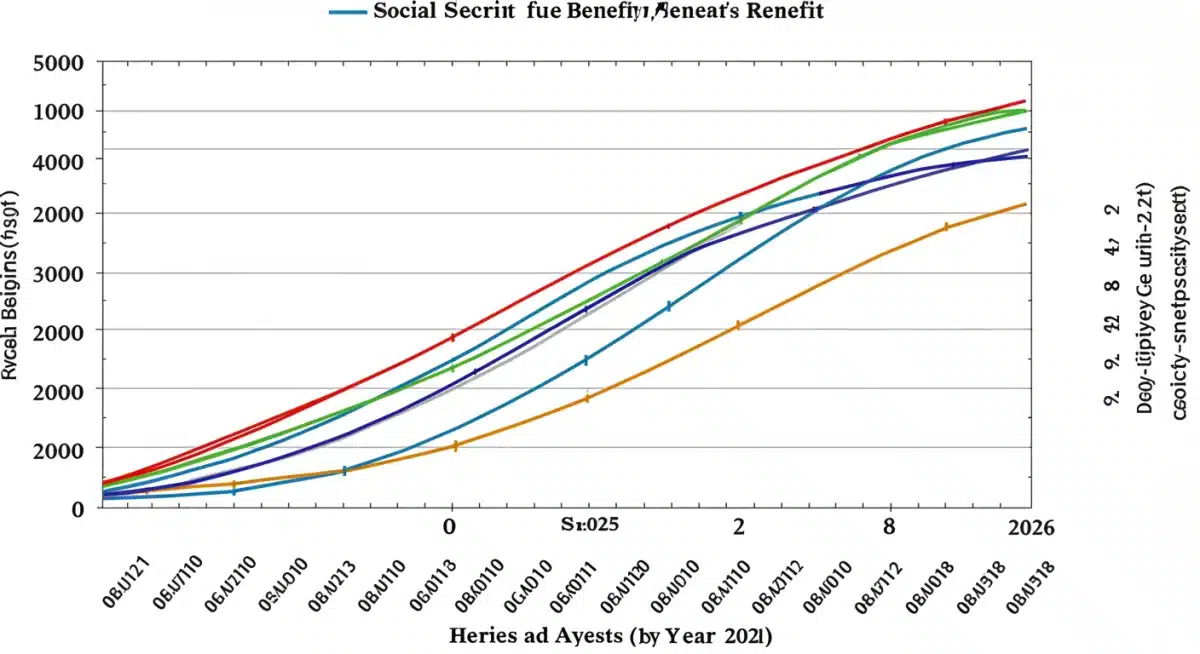
The concept of a break-even point is central to the early claiming vs. delayed filing: analyzing 2026 Social Security break-even points discussion. It represents the age at which the cumulative total benefits received from delaying your claim surpass the cumulative total benefits received from claiming earlier. In simpler terms, it’s the point where waiting longer starts to pay off financially.
To calculate your personal break-even point for 2026, you need to consider several factors: your Full Retirement Age (FRA), your estimated monthly benefit at different claiming ages, and your life expectancy. While the Social Security Administration provides tools and statements to help estimate benefits, personalizing this calculation is crucial. Financial planners often use sophisticated software to model various scenarios, taking into account individual circumstances.
Key Variables in Break-Even Calculations
Several variables significantly influence your break-even point. Understanding these can help you better interpret the results of any calculation.
- Full Retirement Age (FRA): Your FRA dictates the baseline for your unreduced benefits and the percentage adjustments for early or delayed claiming.
- Estimated Monthly Benefit: This is your primary insurance amount (PIA), which varies based on your earnings history.
- Life Expectancy: This is perhaps the most uncertain variable but profoundly impacts the break-even analysis. A longer life expectancy generally favors delayed claiming.
- Cost-of-Living Adjustments (COLAs): Future COLAs will affect the purchasing power of your benefits over time, though their exact impact on break-even is harder to predict precisely.
Generally, for those with an FRA of 67, the break-even point when comparing claiming at 62 versus 67 often falls in the mid-70s. Comparing claiming at 67 versus 70 might push the break-even into the early 80s. These are general guidelines, and individual results will vary based on specific benefit amounts and life expectancy projections.
Ultimately, calculating your 2026 Social Security break-even point provides a clear financial benchmark. It helps you understand when the cumulative benefits from one claiming strategy will overtake another, guiding you toward a decision that aligns with your long-term financial goals.
Factors Influencing Your 2026 Claiming Decision
While the break-even analysis provides a strong financial foundation, several non-financial and personal factors also play a critical role in your 2026 Social Security claiming decision. These considerations can sometimes outweigh the purely mathematical outcome, reflecting the nuanced reality of retirement planning. It’s important to view your Social Security strategy as part of a broader financial and life plan.
Your health and anticipated longevity are paramount. If you have a family history of longevity or are in excellent health, delaying benefits might be a wise choice to maximize your lifetime income. Conversely, if you have significant health issues or a shorter life expectancy, claiming earlier could allow you to enjoy more benefits over your projected lifespan. This deeply personal assessment is often overlooked but is incredibly important.
Personal Health and Life Expectancy
Your health status is a primary driver for many claiming decisions. A robust health outlook supports delaying benefits, while a more challenging health scenario might favor early claiming.
- Good Health: Often suggests delaying to maximize higher monthly payments over a longer life.
- Poor Health/Shorter Life Expectancy: May indicate that claiming early allows for more total benefits received.
Beyond health, your current employment status and other retirement income sources are crucial. If you plan to continue working past your FRA, claiming early might lead to your benefits being reduced due to the Social Security earnings test. Similarly, if you have substantial other retirement savings (e.g., 401(k), IRA, pensions), you might be able to afford to delay Social Security, allowing it to grow.
Family considerations, especially for married couples, also add layers of complexity. The claiming decision of one spouse can significantly impact the other’s survivor benefits. Coordinated claiming strategies can often lead to optimized outcomes for the couple as a whole, rather than individual maximization. All these factors combine to create a complex decision matrix that extends beyond simple financial calculations.
Coordinated Strategies for Married Couples in 2026
For married couples, the decision of when to claim Social Security benefits in 2026 becomes even more intricate than for individuals. It’s not just about maximizing one person’s benefits, but about optimizing the combined lifetime income for both spouses, and crucially, providing for the surviving spouse. A well-thought-out coordinated strategy can significantly enhance a couple’s financial security throughout retirement.
One common strategy involves the higher-earning spouse delaying benefits until age 70 to maximize their monthly payment. This not only provides a larger benefit for their own lifetime but also establishes a higher survivor benefit for the lower-earning spouse. The lower-earning spouse might claim earlier, potentially at their Full Retirement Age, to provide some income while the higher earner’s benefits continue to grow.
Key Coordinated Claiming Approaches
Several strategies exist for couples, each with its own advantages depending on their specific circumstances, health, and age differences.
- Maximize Higher Earner’s Benefit: The higher-earning spouse delays until 70, securing the maximum possible benefit, which also becomes the maximum survivor benefit.
- Lower Earner Claims Early: The lower-earning spouse claims at FRA or earlier to provide immediate income, especially if their individual benefit is significantly smaller.
- File and Suspend (No longer available for new filers): While ‘file and suspend’ was a popular strategy, it was largely eliminated for new filers after April 29, 2016. However, understanding its former purpose helps appreciate current strategies.
- Restricted Application (For those born before 1954): Allows a spouse to claim spousal benefits at FRA while their own benefits continue to grow until age 70. This option is now only available to those born on or before January 1, 1954.
The goal is to analyze scenarios where one spouse’s claiming decision impacts the other, particularly concerning survivor benefits. If the higher-earning spouse passes away first, the surviving spouse will typically receive the higher of their own benefit or the deceased spouse’s benefit. Therefore, maximizing the higher earner’s benefit is often a critical component of a robust spousal strategy.
Couples should also consider their combined life expectancy. If both spouses anticipate a long life, maximizing both benefits through delayed claiming may be the best approach. Consulting with a financial advisor specializing in Social Security can help couples navigate these complexities and devise a strategy tailored to their unique situation for 2026.
Navigating Future Changes and Expert Advice for 2026
The Social Security system, while generally stable, is subject to ongoing discussions about its long-term financial health. While no major legislative changes are anticipated to drastically alter the claiming rules for 2026, it’s wise to remain informed about potential future reforms. These discussions often center on solvency issues, which could lead to adjustments in benefits, eligibility ages, or taxation in subsequent years. Remaining adaptable and informed is key to long-term retirement planning.
Given the complexity and the significant financial implications, seeking expert advice is highly recommended. Financial advisors who specialize in retirement planning and Social Security can provide personalized guidance, helping you analyze your specific situation and make an informed decision about when to claim. They can run detailed projections, taking into account your earnings history, health, other income sources, and family situation.
The Role of Financial Advisors in Your Claiming Decision
A qualified financial advisor can offer invaluable assistance in navigating the nuances of Social Security claiming. They bring an objective perspective and expertise in complex calculations.
- Personalized Projections: Advisors can use specialized software to model various claiming scenarios based on your unique data.
- Holistic Planning: They can integrate your Social Security strategy with your overall retirement plan, including investments, pensions, and healthcare costs.
- Staying Informed: Advisors keep abreast of legislative changes and economic trends that might impact Social Security benefits.
- Spousal Strategies: They are particularly helpful in developing coordinated claiming strategies for married couples to maximize combined benefits.
While online calculators and resources can provide a good starting point, they often cannot capture the full spectrum of personal variables and potential future scenarios. An advisor can help you understand your Social Security break-even 2026 point in the context of your entire financial picture, ensuring your decision is well-rounded and robust.
Ultimately, the best claiming strategy is one that is tailored to your individual circumstances, goals, and risk tolerance. Staying informed about the system and leveraging expert guidance will empower you to make the most advantageous decision for your retirement in 2026 and for years to come.
| Key Point | Brief Description |
|---|---|
| Full Retirement Age (FRA) | The age at which you receive 100% of your Social Security benefit; 67 for those born 1960 or later. |
| Early Claiming Impact | Claiming before FRA results in a permanent reduction of up to 30% in monthly benefits. |
| Delayed Filing Benefits | Delaying past FRA (up to age 70) earns 8% annual delayed retirement credits, increasing monthly payments. |
| Break-Even Point | The age at which cumulative delayed benefits surpass cumulative early benefits, guiding optimal claiming. |
Frequently Asked Questions About 2026 Social Security Claiming
For individuals born in 1960 or later, including many retiring in 2026, the Full Retirement Age (FRA) is 67. This is the age at which you are eligible to receive 100% of your primary Social Security benefit without any reductions.
If you claim Social Security benefits at the earliest age of 62 in 2026, your monthly benefit will be permanently reduced by approximately 30% compared to claiming at your Full Retirement Age (67). The exact reduction depends on how many months you claim before your FRA.
Delaying benefits past your Full Retirement Age (FRA) until age 70 earns you delayed retirement credits. For each year you delay, your monthly benefit increases by 8%, resulting in a significantly higher permanent monthly payout and potentially greater lifetime income.
A Social Security break-even point is the age at which the cumulative total benefits you receive from delaying your claim equal or surpass the total benefits from claiming earlier. It helps determine when a delayed strategy becomes financially more advantageous over your lifespan.
Yes, absolutely. Coordinated claiming can significantly maximize a couple’s combined lifetime benefits and provide crucial survivor benefits. Strategies often involve the higher-earning spouse delaying to age 70 to boost the survivor benefit, while the lower-earning spouse might claim earlier.
Conclusion
The decision regarding early claiming vs. delayed filing: analyzing 2026 Social Security break-even points is far from straightforward. It requires a thoughtful evaluation of financial projections, personal health, life expectancy, and individual retirement goals. While the mathematical break-even point provides an essential guide, it’s equally important to consider your unique circumstances and how Social Security fits into your broader financial landscape. For many, delaying benefits until age 70 offers the greatest potential for maximizing lifetime income, especially if a long lifespan is anticipated. However, early claiming can be a sensible choice for those facing immediate financial needs or health challenges. Ultimately, an informed decision, possibly with the guidance of a financial expert, is paramount to securing your financial well-being in retirement in 2026 and beyond.