Avoid Student Loan Default 2026: Federal Relief Guide

Student loan debt is a significant burden for millions of Americans, and the thought of falling into student loan default can be terrifying. As we look towards 2026, understanding the landscape of federal relief options is more crucial than ever. The consequences of defaulting on your student loans are severe, impacting your credit score, eligibility for future aid, and even leading to wage garnishment or tax refund offsets. But there’s good news: the U.S. Department of Education offers several programs designed to help borrowers avoid this dire situation.
This comprehensive guide will walk you through a 3-step process to navigate federal student loan relief options and prevent student loan default in 2026. We’ll delve into Income-Driven Repayment (IDR) plans, deferment, and forbearance, providing practical advice and insights to empower you to make informed decisions about your financial future. Whether you’re currently struggling with payments or simply want to be prepared, this article is your essential resource.
Avoiding Student Loan Default in 2026: A 3-Step Guide to Federal Relief Options
Understanding Student Loan Default: What It Means and Why Avoid It
Before we dive into solutions, let’s clearly define what student loan default entails. For most federal student loans, default occurs when you fail to make payments for 270 days (approximately nine months). This period can vary slightly depending on the type of loan. Once your loan enters default, the entire outstanding balance, including accrued interest, becomes immediately due. This is known as acceleration.
The Grave Consequences of Student Loan Default
Allowing your federal student loans to fall into student loan default can have a cascading negative effect on your financial life. Here are some of the most significant consequences:
- Severe Damage to Your Credit Score: A default will be reported to national credit bureaus, severely damaging your credit rating. This can make it difficult, if not impossible, to secure future loans (car, home, personal), rent an apartment, or even get certain jobs.
- Loss of Eligibility for Future Federal Student Aid: If you’re in default, you’ll lose eligibility for federal student aid programs, including grants, subsidized loans, and even some scholarships. This can hinder your ability to pursue further education or career training.
- Wage Garnishment: The federal government can garnish a portion of your wages (up to 15%) without a court order to repay your defaulted loan.
- Offset of Tax Refunds and Federal Benefits: Your federal and state tax refunds, as well as certain federal benefits (like Social Security), can be withheld and applied to your defaulted loan.
- Collection Fees: You’ll be responsible for paying reasonable collection costs, which can be substantial and add significantly to your total debt.
- Loss of Deferment, Forbearance, and Income-Driven Repayment Eligibility: Once in default, you lose access to the very programs designed to help you manage your payments, making it harder to get back on track.
- Legal Action: In some cases, the government may sue you to collect the debt.
Given these severe repercussions, proactively working to avoid student loan default is paramount. The good news is that there are robust federal programs in place to help you do just that.
Step 1: Understand Your Federal Student Loans and Current Status
The first and most critical step in preventing student loan default is to understand exactly what you owe and to whom. Many borrowers have a mix of federal and private loans, and the relief options differ significantly between the two. This guide focuses exclusively on federal student loans, as they offer the most comprehensive protections.
Identify Your Loan Servicer(s)
Your loan servicer is the company that handles the billing and other services for your federal student loans. They are your primary point of contact for any questions or issues. To find out who your servicer is, you can:
- Visit the Federal Student Aid (FSA) website and log in with your FSA ID. Your dashboard will list all your federal loans and their servicers.
- Check your credit report.
- Look for statements or correspondence you’ve received about your loans.
Once you know your servicer, contact them directly to confirm your loan types, current balance, interest rates, and repayment status.
Know Your Loan Types
Federal student loans come in several forms, each with slightly different rules and benefits. Common types include:
- Direct Subsidized Loans: For undergraduates with financial need. The government pays interest while you’re in school, during grace periods, and during deferment.
- Direct Unsubsidized Loans: For undergraduates and graduate students. Interest accrues during all periods.
- Direct PLUS Loans: For graduate or professional students and parents of dependent undergraduate students.
- Federal Family Education Loan (FFEL) Program Loans: While no longer issued, many older borrowers still have these. Some FFEL loans are eligible for federal relief, especially if consolidated into a Direct Consolidation Loan.
- Perkins Loans: Low-interest federal loans for students with exceptional financial need. The program ended in 2017, but existing loans remain.
Understanding your loan types is crucial because eligibility for certain relief programs can depend on them. For instance, some older FFEL loans might need to be consolidated into a Direct Consolidation Loan to access specific Income-Driven Repayment plans or Public Service Loan Forgiveness (PSLF).
Assess Your Current Repayment Status
Are you currently in good standing, delinquent, or approaching student loan default? Knowing your status will help you determine the most appropriate course of action. If you’ve missed a payment or two, you are likely delinquent but not yet in default. This is the ideal time to act.
Step 2: Explore Federal Repayment and Relief Options to Avoid Student Loan Default
The U.S. Department of Education provides a robust safety net for federal student loan borrowers. These programs are designed to help you manage your payments during periods of financial hardship and are your best defense against student loan default.
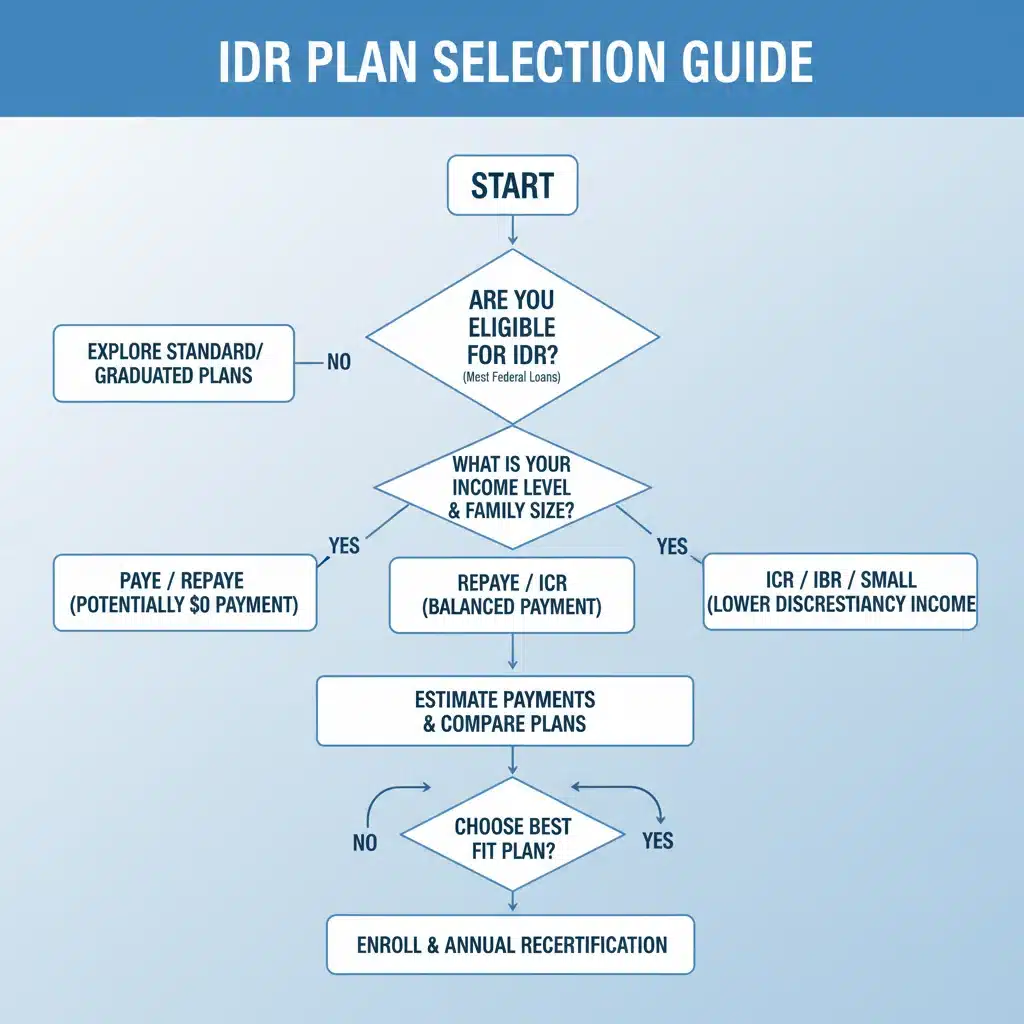
Option A: Income-Driven Repayment (IDR) Plans
IDR plans are arguably the most powerful tool for preventing student loan default. These plans calculate your monthly payment based on your income and family size, rather than your loan balance. This can significantly reduce your monthly burden, sometimes even to $0.
Types of IDR Plans:
- Revised Pay As You Earn (REPAYE) Plan: Generally 10% of your discretionary income.
- Pay As You Earn (PAYE) Plan: Generally 10% of your discretionary income, but never more than the 10-year Standard Repayment Plan amount.
- Income-Based Repayment (IBR) Plan: Generally 10% or 15% of your discretionary income, depending on when you took out your first loans, but never more than the 10-year Standard Repayment Plan amount.
- Income-Contingent Repayment (ICR) Plan: The lesser of 20% of your discretionary income or what you would pay on a repayment plan with a fixed payment over 12 years, adjusted according to your income.
- Saving on a Valuable Education (SAVE) Plan (formerly REPAYE): Introduced in 2023, the SAVE Plan offers significant benefits, including lower monthly payments for many borrowers (especially those with lower incomes) and a provision that prevents your balance from growing due to unpaid interest if you make your full monthly payment. For undergraduate loans, payments will be 5% of discretionary income starting July 1, 2024.
Key Benefits of IDR Plans:
- Affordable Payments: Payments are adjusted to your income, making them manageable even during financial hardship.
- Interest Subsidies: Under some IDR plans (like SAVE), the government may pay a portion of your unpaid interest, preventing your loan balance from growing excessively.
- Loan Forgiveness: After 20 or 25 years of qualifying payments (depending on the plan and loan type), any remaining balance is forgiven. While this forgiveness is generally taxable, it offers a light at the end of the tunnel.
- Path to Public Service Loan Forgiveness (PSLF): Payments made under IDR plans count towards PSLF for eligible public service employees.
How to Apply for an IDR Plan:
You can apply for an IDR plan through your loan servicer or directly on the Federal Student Aid website. You’ll need to provide documentation of your income and family size. Remember to recertify your income and family size annually to keep your payments adjusted.
Option B: Deferment
Deferment allows you to temporarily postpone your loan payments. During deferment, the government pays the interest on subsidized federal loans, meaning your loan balance won’t grow. For unsubsidized loans, interest will still accrue.
Common Reasons for Deferment:
- In-School Deferment: If you’re enrolled at least half-time at an eligible school.
- Unemployment Deferment: If you’re actively seeking full-time employment (up to three years).
- Economic Hardship Deferment: If you’re experiencing financial difficulty (up to three years). This is often an alternative to forbearance if you qualify.
- Graduate Fellowship Deferment: For those enrolled in an approved graduate fellowship program.
- Military Service Deferment: For active duty service members.
Deferment is an excellent option if you qualify, as it can prevent interest from capitalizing (being added to your principal balance) on subsidized loans. Contact your loan servicer to determine your eligibility and apply.
Option C: Forbearance
Like deferment, forbearance allows you to temporarily stop or reduce your student loan payments. However, unlike deferment, interest accrues on all types of federal student loans during forbearance, including subsidized loans. This means your loan balance will likely increase.
Types of Forbearance:
- General Forbearance: Granted by your loan servicer for up to 12 months at a time, if you’re experiencing financial hardship, medical expenses, or changes in employment. You can request up to three years of general forbearance.
- Mandatory Forbearance: Your servicer is required to grant this if you meet certain criteria, such as serving in a medical or dental internship/residency, performing national service, or qualifying for a Department of Defense student loan repayment program.
Forbearance should generally be considered a short-term solution, as the accruing interest can lead to a larger total debt. It’s best used when you have a temporary financial setback and anticipate being able to resume payments soon. Always explore IDR plans and deferment options first, as they offer better long-term benefits in most cases to avoid student loan default.
Step 3: Proactive Engagement and Long-Term Strategies to Prevent Student Loan Default
Simply knowing about these options isn’t enough; you need to be proactive. Waiting until you’re on the brink of student loan default severely limits your choices. Regular communication with your loan servicer and strategic financial planning are key.
Communicate with Your Loan Servicer
This cannot be stressed enough: if you are struggling to make payments or anticipate difficulty, contact your loan servicer immediately. They are there to help you explore your options. Don’t ignore their calls or letters. The sooner you reach out, the more solutions will be available to you.
- Don’t wait until you’ve missed payments. Contact them as soon as you foresee an issue.
- Be honest about your financial situation. They can only help if they understand your needs.
- Keep records of all communication. Note dates, times, names of representatives, and summaries of discussions.
Consider Loan Consolidation
A Direct Consolidation Loan allows you to combine multiple federal student loans into a single new loan with one servicer and one monthly payment. This can simplify your repayment and, in some cases, make you eligible for IDR plans or PSLF that your original loans might not have qualified for (especially older FFEL or Perkins loans).
While consolidation can simplify things, it’s important to understand that it usually means a new, longer repayment period, which can increase the total interest paid over the life of the loan. Your interest rate will be a weighted average of your existing loans, rounded up to the nearest one-eighth of a percentage point.
Review Your Eligibility for Public Service Loan Forgiveness (PSLF)
If you work for a government agency (federal, state, local, or tribal) or a qualifying non-profit organization, you might be eligible for PSLF. This program forgives the remaining balance on your Direct Loans after you’ve made 120 qualifying monthly payments while working full-time for a qualifying employer. Payments made under an IDR plan are typically qualifying payments for PSLF.
Regularly submit the PSLF Employment Certification Form to track your progress and ensure your employment and payments qualify. This is a critical step to avoid student loan default by ultimately eliminating your debt.
Budgeting and Financial Planning
Beyond federal programs, sound personal finance practices are your best long-term defense against student loan default. Create and stick to a budget that accounts for your loan payments. Look for areas to cut expenses and, if possible, increase your income.
- Track your spending: Understand where your money goes.
- Set financial goals: Having clear goals can motivate you to stick to your budget.
- Build an emergency fund: A financial cushion can prevent minor setbacks from escalating into missed loan payments.
- Seek financial counseling: Non-profit credit counseling agencies can offer free or low-cost advice on budgeting and debt management.

Key Considerations for 2026 and Beyond
The student loan landscape is constantly evolving. Staying informed about legislative changes, new relief programs, or policy adjustments from the Department of Education is crucial. Here are some forward-looking considerations:
- The SAVE Plan Expansion: The SAVE Plan is becoming the most beneficial IDR plan for many borrowers. With undergraduate loan payments dropping to 5% of discretionary income in July 2024 and other benefits like interest non-capitalization, it will be a cornerstone of federal student loan relief. Ensure you understand its full benefits and consider enrolling if you haven’t already.
- One-Time Account Adjustment: The Department of Education has been implementing a one-time account adjustment to help borrowers get closer to IDR and PSLF forgiveness. This adjustment addresses past administrative errors and periods of forbearance. Keep an eye on announcements from FSA and your servicer to see how this might impact your loans.
- Interest Rates: While relief programs can lower your payments, understanding current and future interest rates is still important. Higher rates mean more interest accrues, making it harder to pay down your principal.
- Avoiding Scams: Be wary of companies promising quick fixes for your student loan debt, especially those charging upfront fees. Many of these are scams. Always work directly with your loan servicer or the Federal Student Aid website.
Conclusion: Your Path to Avoiding Student Loan Default
The threat of student loan default is real, but it is not inevitable. By understanding your loans, actively exploring the federal relief options available, and maintaining proactive communication with your loan servicer, you can safeguard your financial well-being. The 3-step guide outlined here – knowing your loans, leveraging IDR, deferment, and forbearance, and engaging proactively – provides a clear roadmap for success in 2026 and beyond.
Remember, federal student aid programs exist to help you, not to trap you. Don’t hesitate to seek assistance, ask questions, and utilize the resources provided by the Department of Education. Your financial future is worth the effort.
Additional Resources:
- Federal Student Aid (FSA) Website
- FSA Income-Driven Repayment Information
- FSA Public Service Loan Forgiveness Information
- Your Loan Servicer’s Website and Contact Information